


Page 49 - ISLA_SLReport_Aug2020_double
P. 49
Following the 2007/08 crisis, corporate bonds fell out of   Another factor that can tell us something about the   collateral here in Europe. This has risen from 10% of all
 favour as a collateral class, as some lenders experienced   underlying cash and investment markets that sit behind   government bond collateral in December, to just under
 liquidity issues when trying to sell off against positions   securities lending collateral pools, is the dispersal of   30% in June - a threefold increase.
 held with defaulting counterparties. Since then, there   government bonds in tri-party by domicile.
 Sentiment appears to have   has been an apparent reluctance to embrace corporate   Ordinarily, US Treasuries are relatively expensive to
 changed in the past six   bonds as collateral.   During our last review in December 2019, we observed   finance, and are therefore used elsewhere within the
        a fairly typical jurisdictional dispersal of government
                                                  financial ecosystem to reflect their premium value and
 months with corporate   Sentiment appears to have changed in the past six   bonds in tri-party, with over half coming from Europe,   ensure more efficient use.
 bonds now accounting   34% of all collateral held in tri-party. This is up from   and a further 35% being recorded as JGBs. The picture   Whilst it would be wrong to read too much into one
 months with corporate bonds now accounting for
        as at 30 June 2020 was very different. The use of
 for 34% of all collateral   the 10% reported in December 2019, and is the   European government bonds fell as a proportion of   data point, the use of US Treasuries in this way may
 highest concentration of this asset class we have seen
 held in tri-party. This is up   since we started following these particular statistics   overall government bond collateral, but as the overall   suggest that other forms of collateral were exhausted,
                                                  forcing borrowers to use premium assets.
        use of government bonds did increase, it was probably
 from the 10% reported in   in 2015.  little changed in absolute terms. The use of JGBs fell in
        both percentage and absolute terms, perhaps reflecting
 December 2019, and is   The increasing prevalence of corporate bonds is likely   some dislocation of the previous profitable basis-  As we look forward, it will be interesting to see if the
                                                  use of corporate bonds will continue at the levels seen
 the highest concentration   to have led to higher levels of over collateralisation for   trading arbitrage between US Dollars and Japanese   in June, and how any unwinding of the asset purchase
 of this asset class we have   borrowers, as lenders would have demanded higher   Yen. What is of note however in the latest outputs, is   programmes during the remainder of 2020 and into
                                                  2021 will affect the supply of available collateral.
        the sudden increase in the use of US Treasuries as
 risk buffers to negate the liquidity risks associated with
 seen since we started   accepting this asset class. The use of corporate bonds
 following these particular   sought a more appropriate risk/reward ratio for
 may well have also led to higher fee levels, as lenders
 statistics in 2015  these transactions.

 What is not clear at this point is if this is a temporary
 Not unexpectedly as equity markets came under   shift away from equities towards corporate bonds, or
 pressure, with falling valuations, increased volatility,   whether this is a more permanent feature. We are aware
 and a fall-off in equity positions held by hedge funds,   that many hedge funds have actively sought to take
 the proportion of equities being posted as collateral   positions in the corporate bond sector, and therefore
 fell dramatically to only 13% of all collateral. In the   some of these assets may well be finding their way into
 past where we have seen a decline in the use of equity   collateral pools.   29%
 collateral, we have normally expected it to be replaced
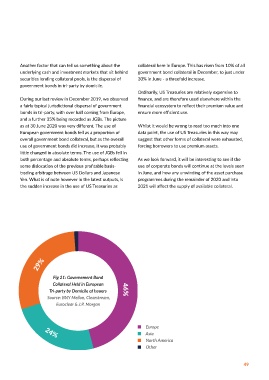
 with government bonds. Whilst the use of government   The data we have does not tell us anything about the   Fig 21: Governement Bond
 bonds increased from 45 to 52% of all collateral pledged,   quality or liquidity of these assets, but we do know   Collateral Held in European
 it was not enough to cover all of the shortfall. As asset   historically that corporate bonds sometimes trade   Tri-party by Domicile of Issuers    46%
 buy-back programmes pulled securities out of the   less freely than mainstream equities or government   Source: BNY Mellon, Clearstream,
 markets, and many underlying institutional investors   bonds. This liquidity risk may well be managed by   Euroclear & J.P. Morgan
 liquidated their holdings of government bonds, they   lenders or their agents through higher levels of over
 appeared less prominent within the collateral eco-  collateralisation (haircut), together with specific
 system than expected.   concentration limits to avoid lenders holding too   Europe
 much of a given issuer or issue. We will of course   24%  Asia
 The most unexpected change in the last six months has   continue to monitor this particular data set over the   North America
 been the renewed use of corporate bonds as collateral.   coming months.  Other


 48                                                                                     49

